Mexico's Sheinbaum pledges to send humanitarian aid to Cuba

MEXICO CITY (AP) — Mexico's PresidentClaudia Sheinbaumannounced Sunday she plans to send humanitarian aid to Cuba this week, including food and other humanitarian aid.

Associated Press

Sheinbaum's comments came after U.S. President Donald Trump said he asked the Mexican leader to suspend oil shipments to theCaribbean island.

Sheinbaum said at a public event in the northern state of Sonora that she did not discuss Cuban affairs in a phone conversation with Trump on Thursday. She added that her government seeks to "diplomatically solveeverything related to the oil shipments (to Cuba) for humanitarian reasons."

Earlier, Trump told reporters that he told the Mexican president not to send oil to Cuba.

Following the U.S. military operation carried out in early January to remove Venezuela's PresidentNicolás Maduro, the South American nation suspended oil shipments to Cuba, which had been declining in recent years.

Advertisement

Mexico then became the main supplier of crude oil and refined products to Havana.

Mexican oil has long acted as akey lifeline for Cuba. In its most recent report, Pemex said it shipped nearly 20,000 barrels of oil per day to Cuba from January through Sept. 30, 2025.

In September,U.S. Secretary of State Marco Rubio visited Mexico City. Afterward, Jorge Piñon, an expert at the University of Texas Energy Institute who tracks shipments using satellite technology, said the figure had fallen to about 7,000 barrels.

Follow AP's coverage of Latin America and the Caribbean athttps://apnews.com/hub/latin-america

Mexico's Sheinbaum pledges to send humanitarian aid to Cuba

MEXICO CITY (AP) — Mexico's PresidentClaudia Sheinbaumannounced Sunday she plans to send humanitarian aid to Cuba th...
Misconduct complaint dismissed against judge who handled El Salvador prison deportation case

WASHINGTON (AP) — A federal appeals court judge has dismissed a misconduct complaint filed by the Justice Department against a judge who clashed with PresidentDonald Trump's administration overdeportations to a notorious prison in El Salvador.

Associated Press

The complaint against U.S. District JudgeJames E. Boasbergwas dismissed on Dec. 19 by Jeffrey S. Sutton, chief judge of the 6th U.S. Circuit Court of Appeals but the order only came to light this weekend.

The complaint stemmed from remarks that Boasberg, the chief judge in the district court in the nation's capital, allegedly made in March 2025 to Chief Justice John Roberts and other federal judges at a judicial conference saying the administration would trigger a constitutional crisis by disregarding federal court rulings. The meeting took place days before Boasberg issued an order blocking deportation flights that Trump was carrying outby invoking wartime authoritiesfrom an 18th century law.

In the dismissal order, Sutton said the Justice Department never provided a listed attachment to provide proof of what Boasberg said or the context of the alleged statement at the closed-door conference.

Advertisement

"A recycling of unadorned allegations with no reference to a source does not corroborate them. And a repetition of uncorroborated statements rarely supplies a basis for a valid misconduct complaint," said Sutton, who was appointed by President George W. Bush to the appeals court circuit that covers Michigan, Ohio, Kentucky and Tennessee.

Spokespeople for the Justice Department and for Boasberg's court did not immediately return messages seeking comment.

Even if Boasberg had made the comments, Sutton said it would not be "so far afield" from topics discussed at the gathering and would not violate ethics rules. Sutton noted that Roberts' 2024 year-end report raised general concerns about threats to judicial independence, security concerns for judges and respect for court orders throughout the nation's history.

The misconduct complaint was filed with Judge Sri Srinivasan, chief judge of the U.S. Court of Appeals for the District of Columbia Circuit, but Srinivasan asked Roberts to transfer it to another appeals court circuit because it was still considering appeals related to the deportation case, according to the dismissal order. Roberts transferred it to the 6th Circuit, it said.

Misconduct complaint dismissed against judge who handled El Salvador prison deportation case

WASHINGTON (AP) — A federal appeals court judge has dismissed a misconduct complaint filed by the Justice Department aga...
He died in a jail cell, pleading for help. No one told his father why.

COMPTON, California – The man in the suit arrived in an unmarked car on a spring morning in 2020 with the worst news James Brown had ever heard.

USA TODAY

His 30-year-old son Jamall was dead.

Brown hadn't heard from him in the days since he was detained on a parole violation. The man – a Los Angeles County deputy sent to notify Brown for the Riverside County Sheriff's Department – would only say that Jamall had been found unresponsive in a jail cell.

"It hit me like a hammer," Brown, 77, said recently. "How did he just die?"

James Brown poses for a photo in his living room at his home in Compton, Calif., Tuesday, Dec. 2, 2025.

For five years, asdetainee after detainee died in the custody of Riverside Sheriff Chad Bianco's jails, Brown kept asking that question.

Finally, in 2025, with the help of a reporter from the Desert Sun, a member of the USA TODAY Network, Brown began turning up answers.

First came the official answer, in a report released from Bianco's coroner's office: Jamall had refused treatment for his diabetes for days, the report said. He died from diabetic complications after or during a methamphetamine overdose.

But a trove of unreleased jailhouse video and detailed internal investigative reports that current and former sheriff's employees provided to Brown and the Desert Sun told a different story.

Those reports confirm that Jamall died of diabetic complications. But they indicate it wasn't because he was rejecting medical aid. The records and video say deputies and nurses ignored Jamall and failed to provide insulin to him for nearly two days. The jail's cameras recorded him saying he was afraid he was dying. They recorded him slipping into a coma in a pile of trash on the floor of his two-man cell. They recorded deputies and nurses looking at him while he lay unconscious, but not intervening. The reports said investigators found no drugs or evidence of them in the cell after his death.

A screen capture from Riverside County jail cell footage shows Jamall Brown in his cell a day before his death in custody of the Riverside County Sheriff's Department as he pleads for help to his cellmate 4:00 a.m. Sunday, March 15, 2020.

Investigators had collected evidence of the staff's failures within hours of Jamall Brown's death, the documents indicated. But for five years, no one told Brown.

Sheriff Chad Bianco and the department's media team didn't respond to requests for comment, including detailed questions about the findings reported in this story, including those in a 6-page administrative review that detailed deputies' failings in Jamall Brown's death.

James Brown says the sheriff's department has been hiding the truth about his son's death.

"My son left this life in agony," he said. "Just because you arrested someone doesn't give you the right to watch them die. I'm still shocked that a cover-up like this is possible."

The pain of living without a son

James Brown served as a military policeman in the Marine Corps and as president of the union that represents workers at the Compton Municipal Water Department, where he worked for about 30 years. He's retired now, but said seeking the truth behind his son's death from the Riverside County Sheriff's Office felt like a full-time job.

In a pile of Father's Day cards he keeps beside his favorite recliner in his Compton home is one Jamall wrote to him in 2018: "Being a father is more than just paying bills and putting food on the table. Once you have the responsibility, you are obliged to help nurture, guide and be a willing participant in every aspect of that child's life and you've been all that plus more for me."

Jamall concluded the greeting card message saying he couldn't imagine life without his father. Two years later, Brown faced the pain of living without his son.

A father's day card written by Jamall Brown to his father, James Brown.

Jamall had been arrested several times while growing up in Compton, a city just south of Los Angeles, and had completed a prison sentence for assault. His father said he was laboring to get his life back on track while living in a tough neighborhood that could easily derail him.

In spring 2020, Jamall travelled about 65 miles east to Moreno Valley, a large suburb in Riverside County, to be near a woman he was dating. His father was not confident Jamall had a steady place to stay and wasn't surprised when he got a call from him. Jamall asked if his dad could send him some money so he could get back to Compton to meet with his parole officer.

Later that evening, Brown heard his wife pick up the phone. Jamall had been arrested and she asked if he wanted to talk to him. Frustrated, Brown declined, assuming his son would be released in a couple of days.

A police report showed that a deputy patrolling a shopping center saw a man pushing a shopping cart with a suitcase in it. The deputy asked him if he was on probation. Parole, Jamall said.

The deputy searched Jamall and his belongings, finding insulin in his luggage and two ecstasy pills in his pocket.

"During my entire interaction with Brown, I did not notice any unusual behavior," the deputy wrote. "I instructed Brown to tell the nurse at the jail he was diabetic and insulin dependent. Brown stated he understood and would tell nursing staff."

Deaths in custody surge

About two years after Jamall Brown died, deaths in custody began to surge in Bianco's department. There were 19 in 2022 alone. An investigation by The Desert Sun and The New York Times of video and internal reports found thatdeputies had ignored detainees leading up to their deaths by suicide. The county's jails also had thehighest rate of homicide in the state. At one facility three people were killed by other detainees in a matter of four months. Evidence gathered by department investigators showed that deputies at that jail had not been properly trained to do mandatory security checks.

Public scrutiny mounted when a former jail captain sued the department, saying Bianco had pressured her not to participate in a civil grand jury investigation of jail conditions and retaliated against jail staff who spoke out about misconduct.

The video and internal reports of Jamall Brown's death, recently leaked to James Brown and The Desert Sun, provide the earliest evidence of the same deputy failures and policy violations amid the recent surge in deaths in the county jails.

Chad Bianco, who is both sheriff and coroner in Riverside County, has defended his department and criticized the state attorney general's investigation into jail deaths.

Internal documents show the jail's medical staff recorded that Jamall Brown was diabetic, insulin-dependent and required blood sugar monitoring. When he was booked, he did not appear under the influence and answered questions coherently, although he mentioned he suspected he might have a mental illness and was noted as a detainee who required extra monitoring.

He spent his first night in custody at the county's central jail in Riverside, where investigators later wrote he was seen eating, sleeping and acting ordinarily.

Transferred to the county's jail in Banning, he was placed in a cell with a camera constantly recording audio and video. A Desert Sun reporter obtained an hour of clips of the video, which recorded Jamall Brown's cell constantly from the evening of March 14, 2020, to the morning of March 16, 2020.  According to the video clips and a deputy's detailed written description of all 40 hours of footage, Brown never received treatment for his diabetes during the time he was at the Banning facility.

Internal records show that soon after Jamall Brown was taken to the hospital in cardiac arrest, the department's investigators began processing about three days of video evidence that captured him losing consciousness as his blood sugar spiked and his heart stopped on the concrete floor.

In jail, Brown died of a medical condition that he had been adequately treating even while unhoused in the days prior to his arrest – a fact department investigators discovered the same day he died.

March 14-15, 2020: First night in jail

On his first night at the Banning jail, video shows that on two occasions a deputy and a nurse opened a pill slot but closed it without speaking with Jamall Brown. Yet they recorded in documents repeatedly during his stay that he had refused medical care.

At 2 a.m., after hours with little food and no medication, the camera captured Brown rubbing his stomach and moaning. He walked unsteadily to the cell's toilet, bumping into the side of the bunk, and drank water before lying down.

A deputy walked by his cell, glancing in through the window before walking away. Minutes later, a deputy is heard on the cell's intercom calling his name and asking: "Do you want your diabetic check?" When Brown didn't answer, the deputy can be heard on video saying, "I'll take your silence as a no."

Exhaustion is a symptom that the body is slipping into diabetic ketoacidosis, as is increased thirst, according to the U.S. Centers for Disease Control and Prevention. A type one diabetic, like Jamall Brown, can begin experiencing this life-threatening condition after as little as 12 hours without insulin.

A screen capture from Riverside County jail cell footage shows Jamall Brown on his top bunk as he pleads for help from his cellmate around 6:00 a.m. Sunday, March 15, 2020.

Jamall Brown didn't stir when the lights turned on the next morning and breakfast was served. Hours later, he woke up confused about what time it was, saying he didn't think the door ever opened.

"Tell 'em I'm dyin', cellie," he said to his cellmate. "Please. Tell 'em I'm diabetic."

Advertisement

A deputy approached the cell, shining a light inside before walking away without interacting with Jamall Brown as he lay on his bunk.

"My stomach hurts bad," he is recorded saying at about 6 a.m. "You want me to die on you?" he said with a groan. "Please, somebody please," he pleaded. No deputy responded through the cell's intercom and his cellmate told him to be quiet.

March 15, 2020: Second day in jail

On his second day in jail without medication, Jamall Brown got off his bunk and attempted to walk around, appearing dizzy.

"Something's wrong," he's recorded on camera saying. Soon after, he can be seen losing his balance, falling against the wall and sliding down.

A screen capture from Riverside County jail cell footage shows Jamall Brown having collapsed from his stool shortly before noon, Sunday, March 15, 2020. From this point, footage did not show Brown standing again before a nurse and deputy found him laying on the ground, not breathing, 19 hours and 56 minutes later.

Over the next several hours, the camera captured Jamall Brown attempting to lift himself up but falling partially into the cell's toilet. He rolled under a table and fell again near a stool. When his cellmate brought in two lunch trays, Brown didn't respond.

Meanwhile, deputies proceeded with the jail's schedule as if nothing was happening. Several deputies walked by, asking if Brown was OK. A few times, Brown's cellmate responded, once saying, "Yeah, he's all right" and another time saying, "He's down and out, fool." Still, deputies left without helping.

March 15-16, 2020: Second night in jail

Jamall Brown spent his entire second night on the floor with labored breathing and minimal movement. At around 2 a.m., on March 16, a deputy used the cell's intercom to ask, remotely: "Brown, do you want to see medical?" He repeated it several times, urging him to respond while Brown didn't appear to move.

"No," his cellmate said.

"All right, thank you," the deputy said. Officials noted that exchange in jail records, saying Jamall Brown refused a diabetic check, though he had not said a word.

For the next seven hours, three more deputies walked past the cell multiple times without looking at or speaking with Jamall Brown, who was now virtually motionless on the floor. Internal reports and video show deputies passing the cell 33 times. Sometimes staff tried to speak to Brown and got no response. Other times they didn't stop at all.

A screen capture from Riverside County jail cell footage shows Jamall Brown laying on the ground in his cell groaning and motionless as a deputy passes by his cell door about an hour before Brown is found to not be breathing, Monday, March 16, 2020. The deputy walked by the doorway and glanced at Brown through the window but did not stop.

"All inmates were breathing and accounted for," one deputy wrote of a 6:30 a.m. security check. At this point Jamall Brown had been on the ground for about 24 hours. He had been without insulin for far longer. An hour later, the same deputy added: "Nothing appeared to be out of the ordinary."

Finally, another hour later, the same deputy and a nurse noticed Brown wasn't breathing.

Aftermath of a jail death

Within three hours of Jamall Brown's death, an internal-affairs sergeant was writing a different version of what had happened.

"Inmate Brown was type-1 diabetic and had refused all medication for several days," wrote John Lenton, a sergeant at the Professional Standards Bureau, which conducts internal affairs investigations. "He was being monitored by jail medical staff in regard to his meds refusal."

In a coroner's report completed months later in September 2020, Assistant Coroner Aimee Roberts repeated that Jamall Brown had refused treatment for his diabetes and added that he had also overdosed on methamphetamine. Though cameras showed Brown collapsing on the floor, Roberts wrote instead that he was "making strange movements" such as doing "head stands" against the wall.

Of hours of video reviewed for this story, the only thing resembling a head stand is when Jamall Brown fell against the wall at an awkward angle.

Dr. Alex Charmoz, the emergency room doctor who handled Jamall Brown's case, reported jail staff told him Brown had been acting "bizarre" and was "shaky or twitchy" before he was  brought to the hospital without a pulse. Charmoz said he was told he'd declined treatment for his diabetes. Charmoz wrote that his blood sugar was at 1,111 — more than 10 times the ordinary level — and that resulting diabetic complications had killed him. Charmoz did not respond to requests for comment for this story.

James Brown looks off into the distance while talking about his son's death while incarcerated in a Riverside County jail at his home in Compton, Calif., Tuesday, Dec. 2, 2025.

In 2025, James Brown received hundreds of pages of sheriff's department reports and video clips capturing his son's final days, materials that were also provided to The Desert Sun.

The reports reveal that, within days of his death, department administrators had collected a highly detailed account of how Jamall Brown was neglected. On March 18, 2020, a deputy completed a 38-page report summarizing the video footage showing him in his cell at the jail, including minute-by-minute descriptions of each of his movements as he lay dying on the cell floor. The department declined to release this report to The Desert Sun but did not dispute its authenticity.

"I want the public to know what really happened to my son," James Brown said. "These reports and video tell a completely different story than what they were trying to sell to me. They had the audacity to let someone die right in front of their eyes."

About a month after Jamall Brown died, Sgt. Marcus Schultz wrote an internal administrative report based on the jail cell video. He found that deputies had failed to perform security checks, monitor the camera as it captured an "inmate who was in medical distress," and inaccurately interpreted the dying man's inability to speak "as a refusal for medical care."

"The proper performance of fundamental, daily responsibilities could have possibly prevented inmate Brown's death," Schultz wrote.

His report was among the documents leaked to James Brown and The Desert Sun.

None of these findings were reported to the public, mentioned in the coroner report or reflected in the department's report on the death to state regulators.

About a month after Jamall Brown died, Riverside County Sheriff's Department Sgt. Marcus Schultz wrote an internal administrative report based on the jail cell video. Among other failures, he concluded that deputies had failed to properly perform security checks.

Another of Schultz's findings excluded from the public reports directly contradicts the department's death ruling: The emergency room doctor noted that the level of methamphetamine found in Jamall Brown's system was not reliable evidence that he had used the drug in jail or that he'd suffered an overdose.

"Due to limitations of the test, medical staff were unable to determine the amount of methamphetamine in Brown's system and were, therefore, unable to determine when he last used methamphetamine," Schultz wrote. His report does not state that methamphetamine had anything to do with Brown's death. It said there was no medical evidence to indicate he was a chronic drug user.

Department officials did not respond to questions about the discrepancy in these reports.

In the aftermath of Jamall Brown's death, Schultz noted, administrators began working to address insufficient security checks. Medical staff were ordered to make sure all refusals of medical treatment were made directly to them and documented.

"No longer will an attempted intercom communication be acceptable," he wrote.

A total of  10 deputies and three nurses failed to intervene when Jamall Brown was having a medical emergency over about two days in 2020. Employment records from 2023 show that all but two deputies captured by the cameras still worked for the department. The department did not respond to questions about the eight deputies are still employed.

Included in the leaked reports is Jamall Brown's death review presentation, which is supposed to be completed within 30 days of a death. It closely reflects what is captured in the video and in the leaked internal incident reports. The presentation does not state that Jamall Brown used drugs while in jail or that he died of an overdose.

James Brown holds up an old school photo of his son, Jamall Brown, at his home in Compton, Calif., Tuesday, Dec. 2, 2025.

While James Brown long ago accepted he'll never see his son again, learning the details of his mistreatment in the care of Riverside county officials has inflicted on him a new kind of pain. He said he sometimes has trouble sleeping when he imagines what his son experienced in his final moments. As he learned more and more disturbing details, he kept fighting to learn the truth. Not just for Jamall's memory, he said, but for all the other people who've had relatives die in the county's jails in the years since.

He said he'll continue to fight for transparency from the department in light of the video and reports he now has. He said the deputies and nurses that let this happen to Jamall need to be held accountable. And he hopes the department will implement real change that puts an end to similar deaths due to neglect.

"This is all a cover up," James Brown said. "They let my son die. They lied about it. It's hurt me to my heart."

This article originally appeared on USA TODAY:Jail documents reveal how a son died on the floor, pleading for help

He died in a jail cell, pleading for help. No one told his father why.

COMPTON, California – The man in the suit arrived in an unmarked car on a spring morning in 2020 with the worst news Jam...
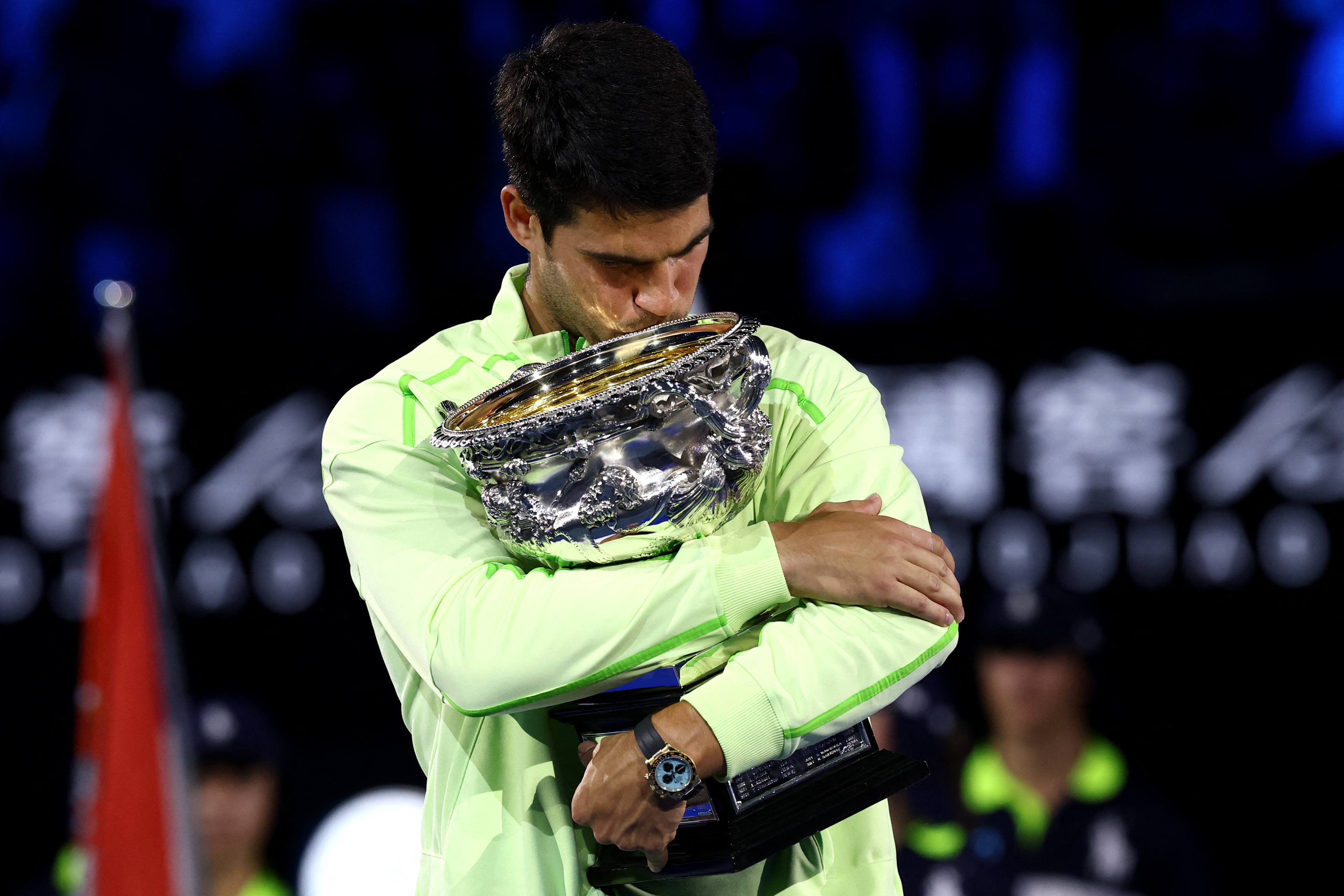
Carlos Alcaraz kisses the trophy after beating Novak Djokovic to win the Australian Open. (IZHAR KHAN / AFP via Getty Images)

Now thathe has won the Australian Open, now that he is the youngest man to complete the career Grand Slam, now that the major title count is at No. 7 with so much career runway to go, we no longer need to be afraid of saying what is obvious.

Novak Djokovic may currently stand as the greatest and most accomplished tennis player of all time, but Carlos Alcaraz is the most gifted person who has ever held a racket.

We are watching Michael Jordan in 1992, Tiger Woods in 2000, Secretariat in 1973. The job is not done, the résumé is still evolving, and the records are not yet theirs.

But our eyes do not deceive us.

This smiling Spanish prodigy, this whirling dervish of speed and power and mental genius, has crossed the threshold between what we thought he could be and what he really is: An absolute monster whose entire package of skills is unequaled by anyone who has ever played tennis.

As someone who grew up on Pete Sampras and Andre Agassi, who cherished how Roger Federer and Rafael Nadal changed the sport and who has grown to appreciate the way Djokovic maintained his body and evolved his game to stay relevant into his late 30s, I don't think that's hyperbole.

Alcaraz has everything. He is him. And he's only going to get better.

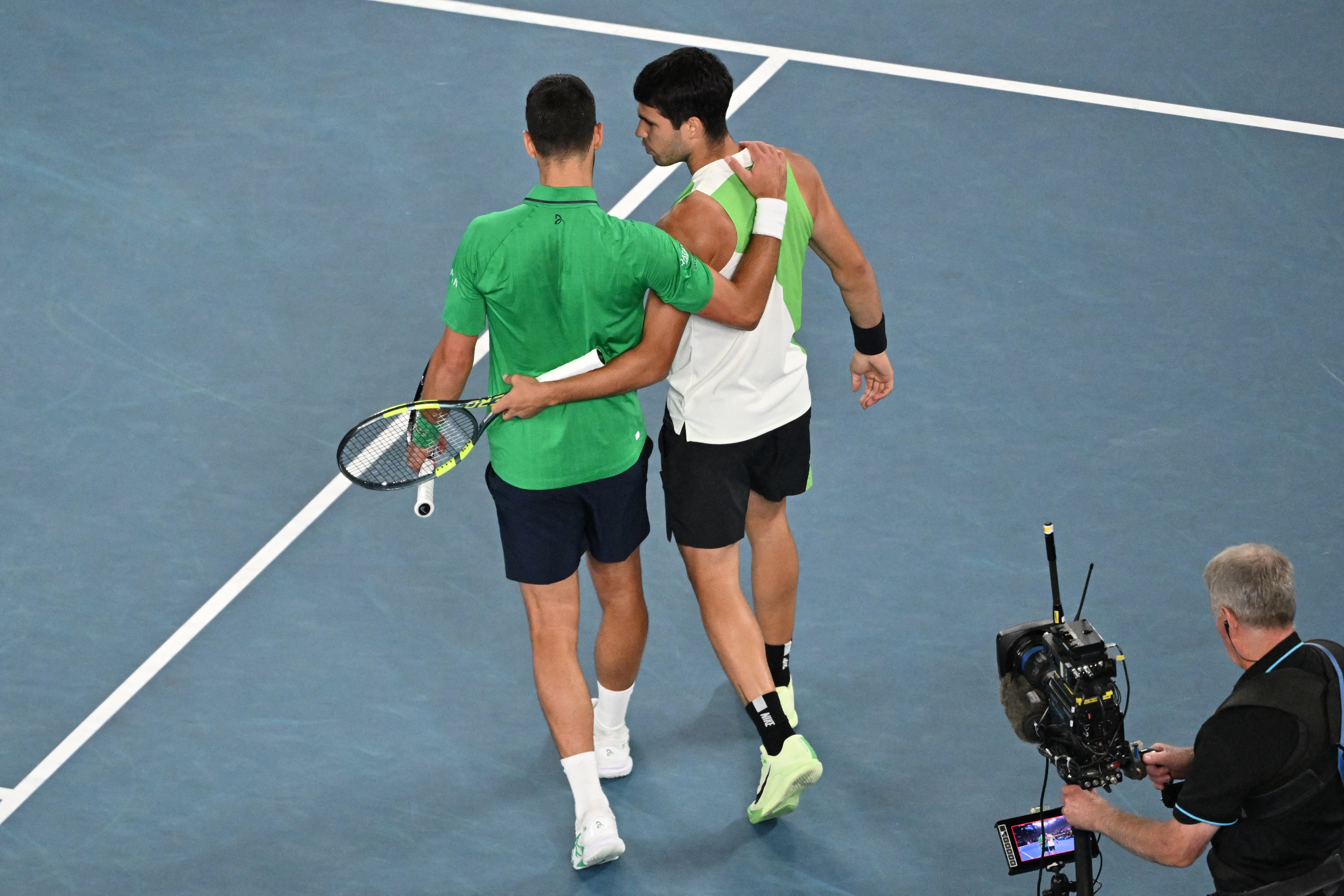
Alcaraz's 2-6, 6-2, 6-3, 7-5 victory in Sunday's Australian Open finallooked the way it probably should have looked between a 22-year-old and a 38-year-old who both played five-set marathons in the semifinals. Djokovic came out on fire, playing arguably one of the best sets of his career, and then began to fade as the younger man imposed his superior physicality. Alcaraz took the punch, started to work Djokovic into the corners and steadily asserted control over the proceedings. In the end, it wasn't all that close.

Despite what was on the line in this match — the career Slam versus Djokovic becoming the oldest man in the Open Era to win a major — starting to think about Alcaraz's place among the all-time greats is not based on this one match. Nor was this Australian final the passing-of-the-torch moment because that happened long before now.

This is about Alcaraz, now having conquered all four tournaments that define tennis greatness, thrusting himself into different conversations. Two years ago, he was picking off majors while working around his flaws. Now, he has none.

It has been a bit cliché to say that Alcaraz combines the best attributes of the Big Three — Roger Federer's creativity and flair, Nadal's competitive spirit and Djokovic's technical mastery. But there's really no case against it. Alcaraz already had all the shots and world-class athleticism when he came on tour as a teenager. But as he's grown up, Alcaraz has added so many layers to his tactical development and sharpened his in-match concentration that it brings to mind what Bobby Jones said in 1965 about Jack Nicklaus, who in turn used the same phrase about Tiger Woods: "He plays a game with which I am not familiar."

Spain's Carlos Alcaraz (R) speaks with Serbia's Novak Djokovic after victory during their men's singles final match on day fifteen of the Australian Open tennis tournament in Melbourne on February 1, 2026. (Photo by Paul Crock / AFP via Getty Images) / -- IMAGE RESTRICTED TO EDITORIAL USE - STRICTLY NO COMMERCIAL USE --

When Nicklaus said that, Woods was on his way to winning his fifth major at the 2000 PGA Championship. At that moment, it seemed a given he would surpass Nicklaus' record of 18.

As we know now, that never happened. Injuries and self-inflicted adversity got in the way, leaving Woods with 15. But for those fortunate enough to remember Woods' peak, the golf we watched him play was simply better than anything anyone had ever seen.

That's where we are with Alcaraz now. This level of tennis is something completely new and different, and it comes from a young man in a big hurry to rewrite the history of the sport.

Already, he is in a club with just nine names: Djokovic, Nadal, Federer, Agassi, Roy Emerson, Rod Laver, Don Budge and Fred Perry are the only men who won all four Slams.

What we don't know yet is whether 24 majors — the most sacred of Djokovic's many records — will eventually come into play. The gap is still huge, and so many things can happen, from injuries to major life changes to motivation to another all-time great coming along whose name we don't yet know.

But at the rate he's going, Alcaraz would need to average two majors per year until he's 31 to break the record. It's crazy to say, given how hard these tournaments are to win, but that feels firmly within the realm of possibility because there really are no more questions for Alcaraz to answer.

Could he win on all surfaces? Yes. Could he eliminate the dips in focus that made things more complicated than they needed to be earlier in his career? It was only a matter of time. Could he turn his serve from a decent shot into a weapon? It happened in one offseason. Could he do it without Juan Carlos Ferrero in his coaching box? Well, he just did.

That last one may not resonate much with casual fans, butthestory of tennis' offseason was Alcaraz separating from the coach who essentially raised him. This was more than just a professional relationship. Ferrero was almost like a second father, and his presence in the biggest moments often seemed like the support blanket Alcaraz needed when he was forced to manage stressful situations.

The details of their break-up are still murky, but they don't matter much. It was just another hurdle for Alcaraz to conquer, and he went to Australia and cleared it with ease. His semifinal win over Alexander Zverev, breaking serve in the fifth set to stay in the tournament, was maybe the most mentally tough victory of his young career.

So what's next? What's remaining?

Just the history left to be made, and putting the numbers behind what our eyes tell us.

While Djokovic, for now, is still the greatest of all time, Alcaraz is the best thing tennis has ever seen.

Australian Open: Novak Djokovic may be the greatest now, but Carlos Alcaraz is coming for his GOAT status

Now thathe has won the Australian Open, now that he is the youngest man to complete the career Grand Slam, now that the major title count ...
LeBron James' All-Star selection streak is at stake, with NBA set to announce reserves

LeBron James' record streak of All-Star Game selections will be on the line Sunday evening, when theNBAreleases the list of 14 players chosen as reserves for the Feb. 15 midseason showcase event.

James is the All-Star record holder in a number of categories. Among them: his active streak of 21 consecutive selections for the game, along with 20 All-Star appearances and 434 points scored in those contests.

The Los Angeles Lakers star was not chosen as a starter this season in the process that includes voting from fans, media and other players. NBA head coaches choose the reserves and, if necessary, Commissioner Adam Silver will select any additional players necessary for the All-Star rosters should someone need to be replaced because of injury.

James did not play in last season's All-Star event because of injury.

This season's All-Star Game has a tournament format —U.S. vs. The World, with three teams of at least eight players going head to head in 12-minute games. Each team is guaranteed two games in the round-robin event, with the best two meeting again in a championship game.

The players chosen last month as starters: Milwaukee's Giannis Antetokounmpo, Boston's Jaylen Brown, Detroit's Cade Cunningham, Philadelphia's Tyrese Maxey, New York's Jalen Brunson, Golden State's Stephen Curry, the Lakers' Luka Doncic, Oklahoma City's Shai Gilgeous-Alexander, Denver's Nikola Jokic and San Antonio's Victor Wembanyama.

The "starter" designation is a bit of a misnomer, since there will be at least 15 players who start in the All-Star Games given that there are three teams. By NBA rule, 10 players are chosen as official "starters" and the 14 others will be listed as "reserves."

Detroit's J.B. Bickerstaff will coach one of the teams. Either San Antonio's Mitch Johnson or Denver's David Adelman will coach another — that will be decided by results of games on Sunday — and the NBA has not revealed how the coach of the third All-Star team will be decided.

Bickerstaff earned his nod because the Pistons lead the Eastern Conference. Johnson or Adelman will go by having the best record in the Western Conference among eligible coaches; Oklahoma City's Mark Daigneault coaches the team with the West's best record, but he cannot coach the All-Star Game this year because he coached in it last season.

The All-Star Game will be played at the Los Angeles Clippers' Intuit Dome in Inglewood, California.

AP NBA:https://apnews.com/hub/NBA

LeBron James' All-Star selection streak is at stake, with NBA set to announce reserves

LeBron James' record streak of All-Star Game selections will be on the line Sunday evening, when theNBAreleases the ...
NHL Ticket Sales Are Up, and It Could Be Because of

Sabrina Lantos/HBO MAX; Getty

People Hudson Williams and Connor Storrie in 'Heated Rivalry,' an NHL game Sabrina Lantos/HBO MAX; Getty

NEED TO KNOW

  • SeatGeek recently claims that NHL ticket sales are up compared to the same period last year

  • The online ticket marketplace said that the jump seemingly coincided with the premiere of the hit HBO show Heated Rivalry

  • The series follows two male hockey players who become involved in a passionate secret romance while competing for dominance on the ring

NHL ticket sales are up — and it may be because of the showHeated Rivalry.

A recent blog fromSeatGeek, an online ticket marketplace, compared NHL ticket purchase trends from three separate weeks between November 2025 and January 2026 with the same weeks from the previous year.

SeatGeek stated that the number of average tickets sold per game "increased by 24%" between week one and week two in late 2025 — noting that the first episode ofHeated Rivalryaired between the two periods. Ticket sales also remained significantly higher during the third week analyzed.

The site said they found no similar increase over the same period as the previous year.

SeatGeek also said that average ticket prices showed a jump afterHeated Rivalryaired, "rising from $127.84 in Week 1 to $142.40 in Week 2."

Hudson Williams and Connor Storrie in 'Heated Rivalry' Courtesy Bell Media

Courtesy Bell Media

They added that there has also been a "surge" in first-time ticket purchasers — meaning in people who have seemingly never bought tickets to a game before — and in solo purchasers.

"Heated Rivalryhas certainly piqued interest in hockeyand the NHL," said SeatGeek's Director of Category Marketing and Endorser Marketing, Chris Leyden, per the blog.

Advertisement

Never miss a story — sign up forPEOPLE's free daily newsletterto stay up-to-date on the best of what PEOPLE has to offer​​, from celebrity news to compelling human interest stories.

"We are seeing it both in terms of more people on SeatGeek shopping for NHL tickets, as well as a pretty notable increase in single ticket buyers as more people check out a game, often for the first time ever," he added.

The PEOPLE Puzzler crossword is here! How quickly can you solve it? Play now!

While the NHL has not commented on the SeatGeek findings, NHL commissioner Gary Bettman recently toldHockey Newsthat he watched the entire first season of the show in one sitting.

"It's a wonderful story," he said, adding, "The content — particularly for young people — may be a little spicy, so you have to balance that out with how you embrace it."

The wildly popular HBO show follows two male professional hockey players — and intense rivals — who become involved in a passionate secret romance. The series quickly became a sensation and catapulted its two stars,Hudson WilliamsandConnor Storrie, to national fame.

The show is based on a 2019 book of the same name by author Rachel Reid. In a December 2025 essay forMaclean's, Reid discussed the "unlikely" success of a queer sports romance.

"It was unlikely that this show would become a runaway hit, but I'm glad people are enjoying it so much," she said. "I hope the success ofHeated Rivalryencourages publishers to not only seek outqueer romances, but to promote them far and wide."

Read the original article onPeople

NHL Ticket Sales Are Up, and It Could Be Because of “Heated Rivalry” Fever

Sabrina Lantos/HBO MAX; Getty NEED TO KNOW SeatGeek recently claims that NHL ticket sales are up compared t...
Venezuela releases at least nine prisoners including activists

Feb 1 (Reuters) - At least nine Venezuelans were released from a notorious Caracas prison on Sunday including human rights activist Javier Tarazona, a relative and a nongovernmental organization said, as families ​of detainees complained the process has been too slow.

"After 1,675 days, four years and seven months, ‌the day we've so wished for has arrived, my brother Javier Tarazona is free," Jose Rafael Tarazona said on X. "The freedom of ‌one is hope for all."

Prisoner releases have accelerated since Venezuela announced a release policy on January 8 in the wake of the U.S. capture of former President Nicolas Maduro on January 3.

Tarazona is the director of FundaRedes, which tracks alleged abuses by Colombian armed groups and the Venezuelan military along the countries' border. He was arrested in July ⁠2021, accused of terrorism and conspiracy.

The ‌released prisoners were held in the Helicoide detention center in the capital Caracas, which a 2022 United Nations report said subjected detainees to torture, an accusation the government rejected.

Local human rights ‍group Foro Penal said on X on Sunday that those released in addition to Tarazona were: Italian Venezuelan citizen Mauricio Giampaoli, political activist Luis Isturiz, farmer Victor Castillo, political leader Yandir Loggiodice, Willians Diaz, Rodrigo Perez, Omaira Salazar and Guillermo Lopez.

"Every step ​towards freedom and the definitive end of repression is important," Gonzalo Himiob, vice president of the group, ‌said on X.

The Venezuelan communications ministry, which handles press queries, did not immediately respond to a request for comment.

Foro Penal has said more than 300 political prisoners have been released in recent weeks and estimated more than 700 remain jailed.

Government officials - who deny holding political prisoners and say those jailed have committed crimes - have put the number of releases at more than double that, though that figure appeared to include releases from prior years.

The government ⁠has not said how many prisoners will be released or ​identified them.

Venezuela's interim President Delcy Rodriguez on Friday announced a proposed "amnesty ​law" for hundreds of prisoners, and said the Helicoide detention center will be converted into a center for sport and social services.

Families of prisoners say the releases have progressed too ‍slowly, and relatives and human ⁠rights advocates have demanded that charges and convictions against detainees who are considered political prisoners be expunged.

Nobel Peace Prize winner and opposition leader Maria Corina Machado, who has several close allies imprisoned, has advocated ⁠for releases.

Prominent still-detained figures include opposition politician Juan Pablo Guanipa and lawyer Perkins Rocha, both close Machado allies, and opposition Voluntad ‌Popular party leader Freddy Superlano.

Rafael Tudares, the son-in-law of former opposition presidential candidate Edmundo Gonzalez, is ‌among those freed.

(Reporting by Reuters; Editing by Cynthia Osterman)

Venezuela releases at least nine prisoners including activists

Feb 1 (Reuters) - At least nine Venezuelans were released from a notorious Caracas prison on Sunday including human righ...


AB MAG © 2015 | Distributed By My Blogger Themes | Designed By Templateism.com