
As the United States hangs on the precipice of a military attack on Iran whilenegotiating a nuclear dealthat would avert a strike, Israel wants the Trump administration to insist on limits on Iran's ballistic missile stockpiles and funding of militant groups, demands that experts say could cause a stalemate in the talks and lead to war.
PresidentDonald Trumptold reporterson Feb. 6 that a deal that only saw Iran commit to eliminate its nuclear weapons, with no other concessions, would be "acceptable."
"Right up front, no nuclear weapons," Trump added.
Iran has expressed openness to a deal if it only involves nuclear issues.
 Anti-government protests in Iran appeared to accelerate on Jan. 9, sparked by anger over the collapse of the country's currency and a broader sense of hopelessness and disillusionment with Tehran's clerical leaders.
The uptick in unrest also comes as President Donald Trump warned Iran's authorities against killing peaceful protesters, saying Washington "will come to their rescue."
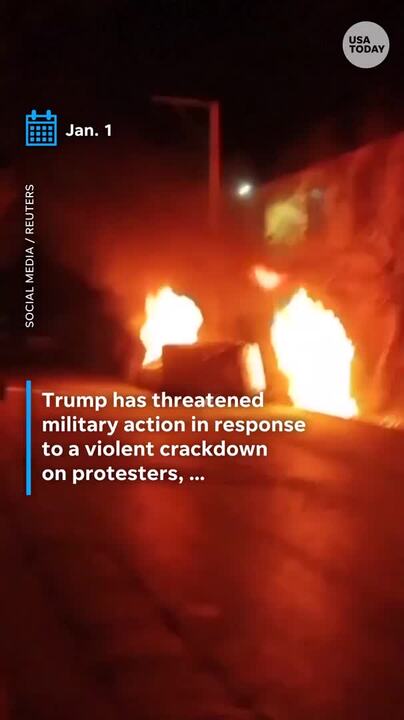
See the scenes in Iran, beginning here on the streets amid anti-government unrest in Tehran, Iran, in this still image obtained from social media video released on January 8, 2026. Witnesses told Reuters protesters gathered in the streets on Thursday, January 8, however this video's date taken has not been verified.


See Iran's anti-government protests, huge crowds, unrest in photos
Anti-government protests in Iranappeared to accelerate on Jan. 9, sparked by anger over the collapse of the country's currency and a broader sense of hopelessness and disillusionment with Tehran's clerical leaders.
The uptick in unrest also comes as PresidentDonald Trumpwarned Iran's authorities against killing peaceful protesters, sayingWashington "will come to their rescue."See the scenes in Iran, beginning here on the streets amid anti-government unrest in Tehran, Iran, in this still image obtained from social media video released on January 8, 2026. Witnesses told Reuters protesters gathered in the streets on Thursday, January 8, however this video's date taken has not been verified.
"We do not discuss any other issue with the U.S.," Iranian Foreign Minister Abbas Araqchi said after the first day of talks between U.S. and Iranian negotiators in Oman on Feb. 6, which he called a "good start."
That red line puts the high-stakes negotiations on a collision course with Israel, which has insisted that Iran's ballistic missiles and its military support for its proxy forces in the region, such as Hamas and Hezbollah, must also be on the table.
Israeli Prime MinisterBenjamin Netanyahuis coming to Washington, DC on Feb. 11, where he is expected to push Trump to hold Iran to those additional conditions. Netanyahu "believes any negotiations must include limitations on ballistic missiles and a halting of the support for the Iranian axis," his office said in a Feb. 8statement.
The United States dropped more than a dozen penetrating bombs onIran's nuclear facilitiesin June 2025. Trump hasrenewed his threatsto reattack in recent weeks, amid the largest protests Iran has seen in decades and a brutal government crackdown in response that has killed thousands.
Ballistic missiles key to Iran's defense
The problem with those non-nuclear demands, according to experts, is that they would require Iran to completely restructure its national security strategy and decades of its defense dogma.
"The ballistic missile program is a key pillar of Iranian defense strategy," said Brian Carter, a research manager at the American Enterprise Institute's Critical Threats Project, who is focused on Iran and its regional partners. "For the Iranians to agree to a condition (limiting it) would be tantamount to a complete rethink of Iranian security policy over the last 10 years or longer than that."
"I don't know what exactly the United States is looking for in terms of limits, but it's an unrealistic expectation," he said.
It's not clear what kind of limit Israel wants to impose on Iran's ballistic missile stockpiles – whether on the number of missiles it could maintain or on the range that the missiles could reach. Iran has both medium-range ballistic missiles, which can reach around 620 to 1,860 miles, and short-range ballistic missiles, which cover a range less than that.
Advertisement
More:US military shoots down Iranian drone that 'aggressively' approached ship
From Iran's perspective, a limit on missile range would be akin to "taking our ability to retaliate and deter Israel while they have no limit on their ability to attack us," said Jim Lamson, a senior research associate at the Middlebury Institute's James Martin Center for Nonproliferation Studies.
A cap on the range of Iran's medium-range ballistic missiles, which can reach Israel, would also not address the risk posed to U.S. bases in the region, which Iran can reach with its short-range missiles. There are at least 40,000 U.S. troopsstationedin the region, as of June of last year, which would be a prime target for Iran's retaliation, if attacked.
"It would not be possible to attack American soil, but we will target their bases in the region" if attacked, Araqchi said on Feb. 6.
Iran's reliance on ballistic missiles as the central pillar of its military strategy dates back to its war with Iraq in the 1980s. "They learned the hard way," Lamson said.

In the years since, Iran built up an "asymmetric" military strategy that centers on ballistic missiles and regional forces and "exploits our defense posture and hits us where we have gaps," according to Carter.
Carter and Lamson both likened a U.S. demand for Iran to give up its ballistic missiles to asking the United States to give up its aircraft carriers – a central facet of American military force and defense strategy. Trumphas dispatchedone of the country's aircraft carriers, the USS Abraham Lincoln, along with its three accompanying warships, to the Middle East amid his threats to attack Iran.
Even if Iran agreed on a limit to its ballistic missile capabilities, verifying its compliance would present an additional set of challenges, Lamson said.
"There's no way" Iran would accept the "intrusive monitoring and verification of ballistic missile development and production facilities" necessary to keep tabs on that limit, he added.
Iran's missile arsenal degraded, but unclear how much
While Israel's attack on Iran during the 12-Day War last June significantly degraded its ballistic missile stockpiles, it's not clear how much Iran has been able to replenish its arsenal.
Gen. Kenneth McKenzie, then the commander of U.S. Central Command,told senatorsin 2022 that Iran had more than 3,000 ballistic missiles. Iranfired370 missiles at Israel during the war last June, around a half to a third of its stockpile, leaving it with around 1,500 missiles left, according to Israeliestimates.
This article originally appeared on USA TODAY:Israel wants ballistic missile limits. Iran won't budge. Is it war?
